
Companies that adapt to ESG earliest create advantages for themselves
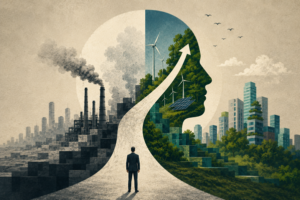
Every industrial revolution has been, at its core, a story about companies adapting to new operating conditions.
The first industrial revolution demanded that businesses learn to work with coal and machinery. Later, it demanded they master electricity and mass production. Then, the digital revolution demanded businesses to rethink distribution, communication, and data.
In each case, the companies that adapted earliest built durable advantage. Those that waited viewed change as disruption rather than strategy.
A Responsible Industrial Revolution is a response to modern-day conditions.
From Friedman to Freeman
To understand where business is going, it helps to understand where it has been.
In 1970, American economist Milton Friedman published an essay in the New York Times that would become the operating philosophy of the corporate world for the next four decades.
In The Social Responsibility of Business Is to Increase Its Profits, he argued that executives are agents of shareholders, so it is their duty to maximise returns. Social problems are for individuals and governments to solve. And any executive who diverts corporate resources toward social ends is, in Friedman’s framing, spending other people’s money without their consent.
Fourteen years later, American philosopher and business professor, R. Edward Freeman published Strategic Management: A Stakeholder Approach, in which he argued that businesses have obligations not only to shareholders, but to every party affected by their decisions, including employees, customers, suppliers, communities, and the environment.
His core claim was almost the antithesis to Friedman’s: that managing for a broader set of stakeholders is the only reliable way to create durable value for shareholders in the first place.
Do responsible businesses perform well?
The answer, based on the weight of current evidence, is yes, but with important nuance.
In 2024, an MSCI analysis revealed that companies in the top ESG quintile outperformed those in the bottom quintile over the 2012-2023 period, highlighting a consistent link between strong ESG performance and superior long-term financial returns.
MSCI’s analysis shows that, while outperformance may arise from multiple expansion in some cases, the main driver is better earnings fundamentals.
Research from McKinsey also supports MSCI’s conclusions and finds that management teams that chase growth without considering how long-term impacts not only increase reputational risk but are also less likely to lead to full growth potential.
That said, ESG benefits appear context-dependent, sector-specific, or only emerge over longer time horizons.

A community of proof
B Lab UK’s ten-year impact report found that UK SME B Corps consistently outperformed the national SME average on revenue growth, headcount growth, and investor funding.
The mechanism, researchers suggest, is not simply that responsible companies are better managed (though that may be part of it). Certification functions as a trust signal that reduces information asymmetry, especially for investors who looking to evaluate intangible assets, for customers making values-based choices, and for employees selecting employers.
Companies that can credibly demonstrate accountability attract capital, customers, and talent on better terms. Those advantages compound and its effect is not limited to Western markets.
In Malaysia, the B Corp community is new but growing. Fuller Impact, an ESG educator and advisory operating across the region and one of the country’s certified B Corps, reflects a broader pattern of professional services firms using certification to differentiate on credibility in a market where ESG claims are increasingly scrutinised.
The ASEAN outlook
The forces behind this transition are converging: capital repricing ESG performance, consumers raising their baseline expectations, a Gen Z workforce selecting employers by purpose, supply chain regulation tightening globally, and mandatory disclosure frameworks arriving across every major market.
Our region carries different institutional histories, different regulatory maturity levels, and different starting points for ESG adoption. Countries across the region sit at different points on that curve; some facing high ESG exposure with limited management capability, others more prepared but equally exposed.
What is also true is that the direction of change is consistent across the region and gaining momentum.
Malaysia’s Simplified ESG Disclosure Guide, designed specifically for small-medium enterprises (SMEs), now aligns with the ASEAN Simplified ESG Disclosure Guide, meaning a Malaysian SME reporting under the framework can satisfy regional supply chain disclosure requests without producing separate reports for different markets.
The deeper point is this: the supply chain linkage means that ESG adoption is not just a listed-company question. Every SME that supplies to a listed company is, in effect, inside the ESG reporting perimeter of that company’s Scope 3 obligations.
The market infrastructure forming around this shift is also worth noting. Platforms like Plixstar reflect growing regional demand for verified responsible products.
Plixstar offers a curated marketplace of verified responsible products, making the shift to responsible procurement a practical starting point rather than an abstract commitment.

Where it gets harder
Certification structures see critics argue that the minimum score required for certification allows companies to signal accountability without genuinely transforming.
Greenwashing is a real and documented phenomenon, and regulators globally are beginning to act on it.
That aside, switching to responsible practices is not cheap, especially for SMEs. Building compliance systems, sticking to reporting rules, and hiring the right people; all of these add real costs.
Small and medium-sized firms feel this burden the most.
Forcing companies to disclose more without giving them the tools or support network to do it just raises hurdles, not standards. However, these challenges do not weaken the case for change.
What comes next
Every prior industrial revolution produced two categories of business: those that understood the new operating conditions early enough to build around them, and those that recognised the shift too late and spent their energy managing the consequences.
The Responsible Industrial Revolution is no different, except that the new operating conditions are not related to a factory floor or in a server room. They are appearing in a capital allocation decision, a procurement contract, a talent offer letter, and a disclosure requirement.
What separates the companies is not intention. It is whether responsibility is embedded in how decisions are made: in governance, in measurement, in the structures that hold the organisation accountable when no one is watching.
The tools to close that gap exist. For instance, Fuller Academy conducts ESG and sustainability-related trainings for teams ready to move from understanding to applying concepts for practical and disclosure purposes.
A Responsible Industrial Revolution will never be smooth or straightforward. Change, especially structural change, is always a bit messy.
The businesses that build that capability now will not simply survive the next decade of regulatory, capital, and social pressure. They will shape what comes after it.